
Sage Oak founder and CEO Loe Hornbuckle was a recent guest on the Senior Housing News Transform podcast. The interview covered the state of the industry heading into 2026, what the next generation of families is going to expect, and why he believes personalization is the thing the industry is still missing.
For families touring senior living in Dallas, the most useful part of the conversation was not the industry outlook. It was the explanation of why a small home on a residential street can deliver something a large building structurally cannot.
Picking a lane versus meeting the person
Most senior living communities build an identity and hope enough families match it. One community leads with a celebrity chef partnership. Another builds around a specific cultural or dietary focus. Hornbuckle’s point in the interview was that this approach is a bet, and the bet only pays off for the families who happen to fit.
The alternative is to build the operation flexible enough that you can meet whoever walks through the door. His argument is that a company designed around personalization from the start never has to reinvent itself when the customer changes, because adapting is already what it does.
That is easier to say than to execute, and the reason it works for us in Dallas is entirely about scale.
Five houses in real neighborhoods, not one campus
Sage Oak operates five licensed Type-B assisted living homes in Dallas: Lakewood on East Mockingbird, Preston Hollow on Forest Lane, Norway Place, Preston Hollow South on Aberdeen, and Top Hill Circle. Four of the five carry Texas certification to care for residents with Alzheimer’s and other dementias.
These are houses in residential neighborhoods, upgraded with safety features and modern amenities. That matters more than it sounds. A resident coming from a home in North Dallas moves into another home in North Dallas. The living room is a living room. The kitchen is a kitchen. Family visiting on a Sunday afternoon sits on a couch, not in a designated visitation area.
Because each house is small, the population inside it can be shaped intentionally rather than left to whoever the referral pipeline sends. Hornbuckle described this as curation, and it can take different forms. At one Sage Oak community, an all-women’s home has worked well. At others, the grouping is built around acuity, cognitive stage, or social fit. Having multiple houses is what makes any of that possible. One building gives you one environment.
Caregivers per square foot
The most quotable idea from the episode was a new way to look at staffing.
Every community quotes a caregiver ratio. Hornbuckle’s suggestion is to divide that ratio into 24 hours to see what it actually buys. At a common industry ratio of roughly 18 residents to one caregiver, you get about an hour and 20 minutes of theoretical direct care per resident per day. Everything a resident needs has to fit inside that window, or the family fills the gap.
Then he added the measure that most people never think about. Any provider can adjust a ratio. What they cannot adjust is the square footage of the building. Staff a large community generously and you still have caregivers who are 150 yards away from the resident who needs them right now. Response time is a function of distance, not just headcount.
In a residential house, there is no distance. The caregiver is in the next room. That is the part a big building cannot copy.
Food is the clearest example of personalization
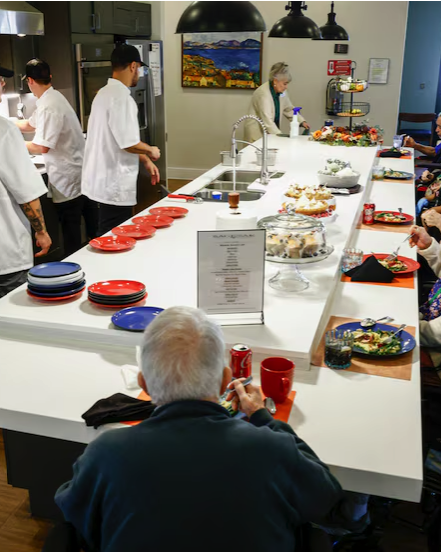
The interview spent real time on dietary programs, which is a subject we have been working on hard in Dallas. Our approach to food was recently featured in the Dallas Morning News.
Hornbuckle’s framing is that the old model was to attach a restaurant name or a celebrity chef to a menu and advertise it. The new model looks more like having a private chef in your home. A private chef asks what you like, what you cannot eat, and what your family wants when they visit, then cooks accordingly.
He shared an example from a Sage Oak home where a resident was nearing end of life and the family had been present for days. The chef noticed, and without being asked, made them grilled salmon, potatoes, and broccoli so they could eat a real meal at the bedside. Nobody put that on a menu. It happened because the kitchen is close enough to the people to notice.
That is what personalization looks like in practice. It is not a program. It is proximity plus attention.
We are not trying to be for everybody
One of the more direct moments in the episode was Hornbuckle saying plainly that Sage Oak is not for every family. The industry standard is an average price for an average service delivered to an average client. Our model is a premium service for a family that is being particular on purpose, and he has no interest in pretending otherwise.
If you are comparing senior living options in Dallas and the size of the building has been bothering you, that instinct is worth following.
Listen to the full episode
The conversation is available on the Senior Housing News Transform podcast, linked here on Apple Podcasts.
To see one of our Dallas homes in person, call (972) 908-9094 or schedule a private tour. We will show you the actual house, introduce you to the caregivers, and talk through which of our five locations fits your family.